
The Impact of Robotics on Modern Industries
Introduction
Robotics has moved far beyond science fiction. Today, it plays a central role in shaping industries by improving efficiency, accuracy, and safety. From factory floors to hospital corridors, robots are transforming how work gets done—often faster and with fewer errors than traditional methods.
What is Robotics in Industry?
Robotics refers to the design and use of machines capable of performing tasks autonomously or semi-autonomously. In industrial contexts, robots are programmed to handle repetitive, complex, or hazardous tasks with high precision.
Key Features of Industrial Robots
- Automation of repetitive tasks
- High precision and consistency
- Ability to operate in dangerous environments
- Integration with AI and machine learning systems
These features make robotics an essential component of modern production and service systems.
Major Industries Transformed by Robotics
1. Manufacturing
Manufacturing is the most heavily impacted sector.
- Robots handle assembly, welding, and painting
- Increased production speed and reduced defects
- Improved worker safety by minimizing exposure to hazardous tasks
Factories are now becoming smart manufacturing hubs, where robots and humans collaborate seamlessly.
2. Healthcare
Robotics is revolutionizing patient care and medical procedures.
- Surgical robots enable minimally invasive operations
- Robots assist in rehabilitation and physical therapy
- Automated systems manage hospital logistics and medication delivery
This leads to better outcomes, faster recovery, and reduced human error.
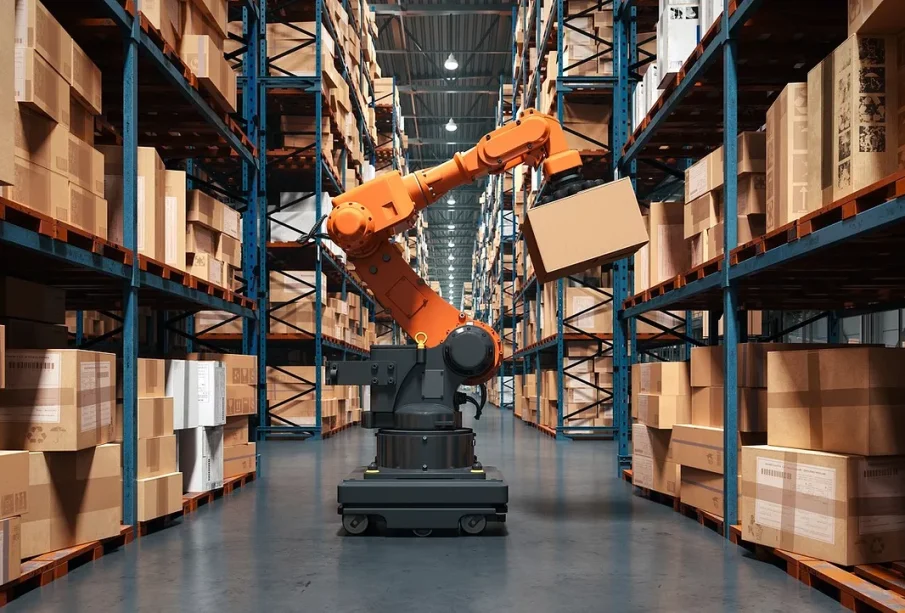
3. Logistics and Warehousing
The rise of e-commerce has accelerated robotics adoption in logistics.
- Autonomous robots manage inventory and sorting
- Faster order processing and reduced delivery times
- Improved efficiency in large warehouses
Companies are using robotics to meet growing consumer demand for speed and accuracy.
4. Agriculture
Agriculture is becoming more technology-driven.
- Robots perform planting, harvesting, and monitoring crops
- Drones analyze soil and crop health
- Reduced labor dependency and increased yield
This helps farmers optimize resources and improve productivity.
5. Retail and Customer Service
Even customer-facing industries are adopting robotics.
- Robots assist in inventory management
- Automated checkout systems reduce wait times
- AI-powered robots enhance customer interaction
Retail is becoming faster, smarter, and more personalized.
Benefits of Robotics in Modern Industries
Increased Efficiency
Robots can work 24/7 without fatigue, significantly boosting productivity.
Improved Accuracy
They reduce human error, especially in tasks requiring precision.
Enhanced Safety
Dangerous jobs can be handled by machines, protecting human workers.
Cost Savings
Although initial investment is high, long-term operational costs decrease.
Challenges and Concerns
Despite its advantages, robotics comes with challenges:
- High implementation costs
- Job displacement concerns in certain sectors
- Need for skilled workforce to manage robotic systems
- Ethical concerns around automation and decision-making
Balancing innovation with social impact is critical.
The Future of Robotics
The future of robotics is closely tied to advancements in artificial intelligence and machine learning.
- Robots will become more adaptive and intelligent
- Increased collaboration between humans and robots (cobots)
- Expansion into new fields like education, hospitality, and space exploration
As technology evolves, robots will not replace humans entirely but will act as powerful tools that enhance human capabilities.
Conclusion
Robotics is redefining industries by introducing smarter, faster, and safer ways of working. While challenges remain, the benefits far outweigh the drawbacks when implemented responsibly. The industries that embrace robotics today are likely to lead the innovation race tomorrow.
FAQs
1. What industries use robotics the most?
Manufacturing, healthcare, logistics, and agriculture are among the top industries utilizing robotics.
2. Will robots replace human jobs completely?
No, robots are more likely to complement human work rather than fully replace it.
3. What are collaborative robots (cobots)?
Cobots are robots designed to work alongside humans safely and efficiently.
4. Is robotics expensive to implement?
Initial costs can be high, but long-term savings and efficiency often justify the investment.
5. How does robotics improve safety in industries?
Robots take over hazardous tasks, reducing the risk of workplace injuries.
6. What skills are needed for careers in robotics?
Skills in programming, engineering, AI, and data analysis are highly valuable.
7. What is the future scope of robotics?
Robotics will expand into more industries with smarter, AI-driven capabilities and increased human collaboration.